
Why Chicago Apartments Get Dirtier Faster: Urban Particulate, City Water, and Seasonal
Rail dust, hard water, winter salt, construction particulate - each one explained by cause.
The 5 Core Environmental Factors That Accelerate Chicago Grime
Chicago apartments get dirtier faster than apartments in most American cities – and there are specific reasons why.
It’s not the size of the unit. It’s not how often you clean. It’s the environment Chicago puts every apartment in – a combination of five distinct factors that work continuously against clean surfaces. Once you know what each one does, you can stop cleaning the wrong surfaces more often and start cleaning the right surfaces in the right way.
These aren’t random dirt patterns. They’re predictable. The same surfaces accumulate the same type of grime in apartments across Chicago’s North Side. The gray film on the window sill. The white crust at the base of the faucet. The grit that reappears on entryway tile two days after mopping. Each one has a specific cause..
How Living Near an L Train Line Affects Your Indoor Surfaces
Urban rail particulate — fine metallic and carbon dust from the L system’s braking — is a primary reason Chicago apartments get dirty.
Urban rail particulate is exactly what it sounds like: tiny particles of metal and carbon released when train wheels brake against elevated rail lines. The Chicago L system runs through dense residential corridors on the North Side. The Brown, Red, and Purple lines pass within a block or two of thousands of apartment windows.
Those particles don’t stay outside.
Apartments within a few blocks of an elevated line accumulate a distinct gray-black dust on window sills, floors near windows, and HVAC intake surfaces. It’s finer than regular household dust. It settles faster and adheres more stubbornly to glass and painted wood. A quick wipe moves it around. A proper clean removes it.
If your window sills are noticeably darker than the rest of your apartment and you live near an elevated rail corridor, that’s rail particulate. It’s also one reason why interior window cleaning in Chicago requires different pressure and technique than it would in a suburban home with no L line nearby.
The effect compounds in summer. More windows open, more particulate enters, and Lake Michigan humidity causes it to stick to surfaces more aggressively than it would in dry air.
Chicago's Water, Air, and Seasonal Cycle - All Working Against a Clean Apartment
Five factors accelerate grime in Chicago apartments: hard water minerals, rail dust, construction particulate, winter salt tracking, and vintage building airflow limitations.
How Does Chicago’s Hard Water Cause Mineral Scale on Fixtures?
Chicago’s water supply comes from Lake Michigan. It goes through treatment before it reaches your tap, but it still carries measurable calcium and magnesium — the minerals that make water “hard.” Chicago’s municipal water falls in the moderately hard range, which is enough to leave visible scale.
When that water evaporates — on tile, at a faucet base, on glass shower doors — the minerals stay behind. That white crust is calcium deposit. It builds with every use and every rinse. Mild soap and a sponge don’t dissolve it. The longer it sits, the harder it bonds to the surface beneath it.
Bathroom fixtures and kitchen sinks accumulate Chicago hard water stains faster than most residents expect. This is a material chemistry issue, not a frequency issue. The right descaling agent addresses it.
How Does Ongoing Construction in Chicago Affect Your Indoor Air Quality?
Chicago runs one of the most continuous urban construction programs in the Midwest. Active construction within a block or two of your building generates airborne concrete dust and drywall particulate throughout the warm months.
This particulate enters through open windows and HVAC systems. It settles on horizontal surfaces — shelves, counters, baseboards — and creates a fine white-gray layer that is denser and more abrasive than ordinary household dust. In neighborhoods like River North, Lincoln Park, and Logan Square, where new development and gut-rehabs are ongoing, this is a year-round variable even in buildings that are themselves fully renovated.
What is the Long-Term Impact of Winter Salt on Chicago Entryway Floors?
The city of Chicago treats sidewalks and public walkways with salt and sand during winter. This is Chicago’s sidewalk treatment program — it works for traction, but the material doesn’t stay outside.
Residents track it directly onto entryway floors with every trip indoors. Salt doesn’t dissolve the way mud does. It dries into a white powder and reappears on floors every time someone walks through after a fresh precipitation event. In buildings with shared entryways, it compounds. In vintage courtyard buildings with long entry corridors, it reaches the unit door.
Mopping helps temporarily. The source keeps refreshing as long as there’s snow or ice on the sidewalk and salt on the ground. This is why deep cleaning bookings in Chicago consistently spike in late February and early March — residents reach the point where seasonal accumulation has gotten ahead of maintenance cleaning.
How Does Lake Michigan Humidity Cause Dust to Bond to Surfaces?
Chicago’s proximity to Lake Michigan creates seasonal moisture patterns that affect how particulate behaves indoors. Summer humidity — particularly in July and August — causes dust and other airborne particles to become sticky. They adhere to surfaces rather than remaining loose.
In a dry climate, dust stays on surfaces lightly and wipes away easily. In a humid Chicago summer, the same dust bonds to the surface it settles on. This makes the same accumulation harder to remove in August than it would be in January.
What is Urban Rail Particulate and How Does It Affect L-Train Adjacent Homes?
A large share of Chicago’s North Side residential stock is pre-1960 construction — two-flats, courtyard buildings, and coach houses. These buildings were built before mechanical ventilation was standard. Most do not have bathroom fans that exhaust to the outside, and kitchen ventilation is minimal.
Without positive airflow, particulate that enters the apartment accumulates rather than cycling out. Humidity builds rather than dissipating. The combination accelerates surface accumulation across the entire unit, not just near windows or entryways.
Residents in vintage buildings near Wicker Park, Logan Square, and Bucktown — all within Shine Up’s service area — consistently show faster surface accumulation than residents in newer high-rise construction with forced-air systems.
The High-Risk Surfaces in Every Chicago Apartment
Chicago apartment grime follows predictable patterns. Each surface accumulates a specific type of buildup, driven by a specific cause.
Knowing which surface accumulates which type of grime tells you which cleaning method is appropriate – and which surfaces a quick wipe-down will never fully address.
Window glass and sills. These accumulate the fastest. Urban rail particulate, construction dust, and humidity-bonded grime layer on glass and on painted wood sills simultaneously. Glass needs a streak-free solvent and the right cloth. Sills need a damp wipe followed by a dry pass to prevent redeposit.
Bathroom fixtures – faucets, tile grout, shower doors. Hard water mineral deposits, also called scale, build on every surface that water touches and then dries. The buildup is invisible when thin and obvious when thick. It requires an acid-based descaling solution – not a scrub pad, which scratches the surface without dissolving the deposit.
Entryway floors. Salt and sand from Chicago’s winter sidewalk treatment accumulates here with every return trip from outside. Mopping reactivates the salt temporarily, which is why entryways can look clean and then hazy again once the floor dries. A rinse-mop sequence removes more than a single pass.
Baseboards near radiators. Radiator heat pulls air upward from the floor. That airflow carries fine dust along the baseboard edge and deposits it in the small gap between baseboard and floor. In vintage buildings with cast-iron radiators, this pattern is consistent. The dust compacts in that gap rather than staying loose, which is why a vacuum extension tip removes it more completely than a cloth wipe.
Expert Observations from 7 Years of Chicago Cleaning
After seven years of cleaning apartments across Chicago’s North Side, one pattern repeats: residents are cleaning consistently, but focusing on the wrong surfaces.
I’ve been in apartments where the kitchen counter is spotless and the cabinet doors above the counter are coated in a thin film of grease and construction dust. The resident cleaned what they saw at eye level. The surface that needed attention was six inches higher.
The window track is the other one. I see clean glass and a window track full of compacted rail particulate and dead insects on nearly every visit in apartments near an elevated line. The glass looks fine. Open the window and the particulate falls right onto the sill you just cleaned.
The third pattern is bathroom tile grout. Chicago’s hard water turns grout lines gray-tan over months. Residents assume it’s mold. Sometimes it is. More often it’s calcium and soap scum bonded to the grout surface. Those respond to completely different products. Using a descaler on actual mold does nothing. Using a mold treatment on mineral buildup does nothing either.
Seven years of cleaning apartments in Wicker Park, Lakeview, River North, and Lincoln Park gives you a clear picture of Chicago’s grime patterns. The city doesn’t make apartments dirty in a random way. Specific surfaces accumulate specific grime, and the fixes are specific too.
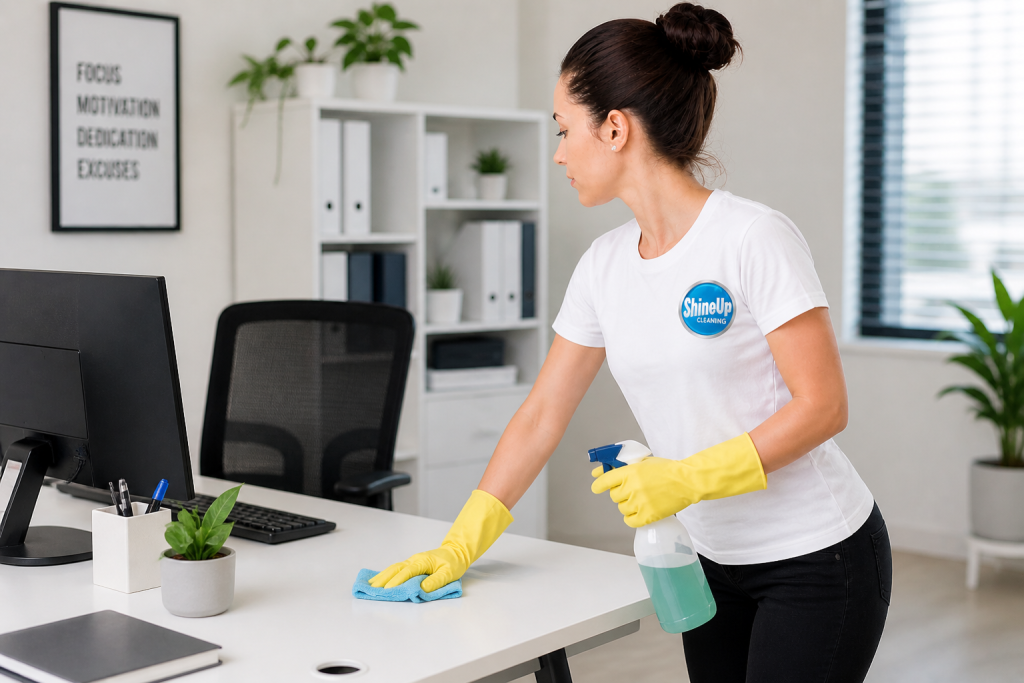

When Chicago's Environmental Buildup Goes Past What a Regular Wipe-Down Fixes
A maintenance clean handles surface dirt. Environmental buildup in Chicago apartments requires a deeper approach.
A regular cleaning visit — wiping surfaces, mopping floors, scrubbing fixtures — handles current accumulation. It does not address bonded mineral deposits, compacted baseboard dust, or grime that has worked into grout lines over months of the Chicago seasonal cycle.
Here’s how to tell when a deeper clean is the right call:
- The white scale on your faucet doesn’t wipe off — it has to be dissolved.
- The window tracks are visibly dark regardless of how recently you cleaned the glass.
- The tile grout looks permanently gray even after scrubbing.
- The entryway floor looks clean when wet and hazy when dry, every time.
Those are the signs that surface cleaning alone won’t recover the space. A professional deep cleaning uses the right product chemistry for each surface type — descaling agents for mineral deposits, appropriate pH products for grout, proper technique for rail particulate on glass. House cleaning on a regular schedule keeps accumulation from reaching that point after the first reset.
If you’re not sure whether your apartment needs a maintenance clean or a full reset, the bathroom fixtures and window tracks are the tell. Those two surfaces reflect how long the environmental factors have been working.
Chicago Neighborhoods Where We Clean Apartments Affected by Urban Environmental Buildup
Shine Up Cleaning serves Chicago’s North Side and Near West corridors — the areas where these environmental factors are most concentrated.
We work within a 6–10 mile radius of ZIP code 60661. That covers the following neighborhoods — corridors where vintage building stock, L train proximity, ongoing construction, and municipal sidewalk treatment all overlap:
Please note: We do not serve the South Side.
Book a Chicago Deep Clean That Targets the Right Surfaces
Now that you know what’s causing the buildup, the next step is a clean that addresses it correctly.
A surface wipe won’t dissolve calcium scale. A mop pass won’t lift compacted rail particulate from a window track. The right clean uses the right method for each surface — and Shine Up has been doing exactly that in Chicago apartments for seven years.
Call us to book. We’re available seven days a week, 9:00 AM to 6:00 PM, including same-day appointments when slots are open. Tell us what you’re seeing and we’ll tell you exactly what type of clean addresses it.